Showing posts with label alms. Show all posts

Saturday, October 19, 2013

Bittersweet.

Braselton, GA – 

Fifteen years. Compared to NASCAR’s 65 years running, not a big number. Compared to Indy and Le Mans’ ACO and FIA at or above 100 years each, barely a flash in the pan. Yet, in 15 years – the last twelve of which I’ve spent covering the American Le Mans Series – we have seen storied battles on pavement between global manufacturers and upstart privateers. We have seen a showcase for future technologies being tested in competition. We have seen history being made at high speed all over North America. In 15 years, some of the best racing anywhere has taken place in ALMS. 

With the series to be absorbed into the Tudor United Sports Car Championship in 2014, this year’s Petit Le Mans closed out the ALMS season – and the series itself – on an unusually wistful note. 

“It’s kind of sad, isn’t it? I mean… it’s an end of an era.” So said Muscle Milk Pickett Racing’s Lucas Luhr, prior to the start of Saturday’s last-ever ALMS race, which summed-up the overall feel on the paddock last week. Adding to the tinge of sadness in the air was the pain of loss within the motorsports family. Famed young Porsche ace Sean Edwards was killed in a crash in Australia on Tuesday while instructing a student, and his team made the decision to remove the No. 30 MOMO Porsche 911 GT3 from competition. The Porsche’s livery was redone in a tribute to Edwards, and taken for a solitary lap prior to the race. 


The undercurrent of sober reflection was inescapable. Edwards was a popular driver and proven talent in GTC class. At 26, likely not yet into his prime, he was leading the Porsche Supercup Championship points race at the time of his death. 

Thus, it was almost poetic that the 1,000-mile contest began with a somber backdrop of light rain, which continued for most of the daylight hours, before eventually giving way to clearer skies and cool October breezes for the finish. 

Among the other points of interest from Petit: 

All week long, it seemed much of the discussion on the paddock and trackside seemed to center not so much on the race itself, as what we might expect for next year. That is, because so little information has been made available to the teams competing in TUSCC starting in just 3 months. The series schedule was only recently released, and car specifications have been slow to come. As a result, a number of top teams have been slow to commit – Greg Pickett’s Muscle Milk Racing, Dyson Racing, and Scott Tucker’s Level 5 Motorsports are just three out of a considerable number of ALMS regulars who have yet to announce plans for 2014. 

As one division in sports car racing is coming to an end with ALMS and Grand Am becoming one series, another rivalry of sorts is apparently developing: The FIA’s World Endurance Championship, responsible in no small part for drawing talent away from existing Le Mans-style racing series in the USA and Europe, has events scheduled in conflict with the new combined series. Since the first weekend of October is the new black, apparently, WEC’s Fuji date on the same weekend as TUSCC’s Petit Le Mans in 2014. 

NASCAR’s K&N Pro Series made an appearance at the track, though rain forced the series to spend most of their scheduled time idled on the paddock. Unable to account for the damp Fall weather (read: no wet tires), the “stock cars” completed a brief practice session early in the week, only to have later practices and qualifying rained-out. They did run a full race on Friday, which was still good fun to watch. 

While the NASCAR teams were frustrated by moist track conditions, the IMSA Lites and Playboy Mazda MX-5 Cup series put on an excellent show in both wet and dry. Most notably in MX-5 Cup, a last-lap battle between Elliott Skeer, John Dean II, and Patrick Gallagher brought fans – and announcers – to their feet, with the three finishing in the aforementioned order. Skeer won the final race of the season, but ended up 4 points shy of series championship winner Christian Szymczak. 

An item that’s surfaced in the last day or two: According to sources within IMSA, one possible change for 2014 may be in the series’ safety team. That is, there might not be one. While IMSA for years has had its own dedicated safety crew traveling with the series, “the NASCAR way” has always been to have a series liaison to coordinate with local firefighters, EMTs and paramedics at each of the tracks – and this is said to be the policy TUSCC wants to adopt. NASCAR claims this is due to “risk management and the series’ insurance policies,” which is shorthand for “this is how we always done it on the cheap, and we don’t like changin’ things.” Outside the world of France family racertainment, however, it’s a travesty. Ask any driver. It is one of many points of contention that need to be settled before the green flag drops at the 24 Hours of Daytona in January. 

That’s it for now; I’ll see you at the next pit stop. 


Tuesday, September 03, 2013

The Street Giveth, and The Street Taketh Away

Baltimore, MD –

Ten years ago, while working a stint for the Mayor’s Office in Baltimore, the thought occurred to me as I was driving home through the streets, “it sure would be cool to see a sports car race through here some day.” Of course, I’ve probably said that about ¾ of the cities I’ve driven through over the years – and who would ever think of doing a race on the streets of Baltimore, anyway? In those days, the city was known nationally as little more than the backdrop for HBO’s The Wire, a show sometimes criticized for being too true to life. Too gritty. Too brutal. Too real. If Los Angeles has a polar opposite, it’s covered in Old Bay seasoning, hon. Baltimore is a picture of working class hard times, and not unlike Detroit has suffered economically for decades. The city’s got scars, ugly ones, and they’re front-and-center.

Of course, there was no way a major race could ever happen. Baltimore, for all its picturesque aerial shots of the Inner Harbor, has way too many counts against it. It’s one thing to whip-up a concrete canyon in a city where snow is something you only see on TV (that’s you, Long Beach & St. Pete), but here? With streets in such characteristically mid-Atlantic shape, they’ll turn a new car’s suspension into crab cake mush in a few months. It’ll never work.

Except that, for the last couple of years, it mostly did.

In the face of local media trashing the race weekend at every turn, and mixed support from the surrounding community (some businesses won, others lost), the first two years of the Grand Prix of Baltimore at the very least showed some promise. That is, literally the promise that much of the hazardously bumpy street surface at the rail tracks would be remedied. Hastily-poured chicanes on the Pratt St. front stretch were problematic in 2011 and 2012, but assurances had been made from all sides that “next year” the chassis-crunching curbs and rail gulleys would be tamed and the track would be so much better.

This year, all hell broke loose. Every series that showed-up – Indy Lights, ALMS, and IZOD Indycar – saw critical damage to numerous cars in every class, the chicanes and tire-barriers turning the circuit into a stunt course more worthy of “Ironman” Ivan Stewart’s off-roader than Patrick Dempsey's Porsche. Starting with a massive crash at the beginning of Saturday’s ALMS race before the field could even take the green flag (resulting in an hour-long delay that shortened the race duration from 2 hours to 1 hour 15 min), and Race Control for each series that seemed to be watching a NASCAR race somewhere, nearly everything that could go wrong, did. For every driver on every team, the ALMS race was hardcore penance for all sins real or imagined that have ever been committed in the name of competition.

As long as we’re complaining, even the humidity was awful. Again.

Sunday’s Indycar race may not have seen half the field turned into a carbon fiber modern art sculpture before it could even get started, but was yet another carnage-laced crash fest. With virtually no suspension travel, the Indy cars simply launched off the chicane curbs – and sometimes plowed into the tire barriers, keeping pit crews at the ready with new nose-pieces. On the dramatic side, the ongoing soap opera between Scott Dixon and Will Power added another chapter, courtesy of Power’s brain-fart which crashed-out Dixon’s car. It wasn’t good racing, but it was still a better story than Twilight.

Indycar may be comparable to vampires vs. werewolves, but for 2014 USCR is taking the shape of a hastily-cobbled together Frankenseries. As yet, teams and suppliers are still awaiting crucial specifications, schedules, pretty much the whole framework they should expect to be working with… and it’s not there yet. Memo to the offices in Daytona Beach: You’re late, and it looks bad.


Back to Baltimore: For all its faults, the city known for gritty TV shows, Super Bowl champs, and white marble steps, still has something to work with. Other circuits have gone through growing pains, and the harsh reality is that more of them are consigned to the scrapheap of history than on an active schedule.

We’ll know, soon.

That’s it for now; I’ll see you at the next pit stop.


Sunday, March 17, 2013

“Human sacrifice, dogs and cats living together... mass hysteria!”

Sebring, FL –

This year’s Mobil 1 Sebring 12 Hours brought with it two major dramatic themes. Both involve the closing of an age.


For nearly as long as the American Le Mans Series has run, one of its biggest attractions has been the super high-tech presence of Audi’s LMP team. Their drivers have always been among the world’s finest, often with Formula 1 pedigree (indeed, the years-old joke on the paddock is that F1 is the “feeder series” for Le Mans sports cars), nearly as diversified as the UN, or at least Angelina Jolie’s nursery.

Thus, with the FIA World Endurance Championship continuing to play to the more sterile but market-friendly circuits (its only US date for 2013 being COTA in Texas), and with the LMP1 class departing from the series after this year, the Audi team returned for a Swan Song run – a thank you and farewell to the fans and the series, and as always a tune-up for Le Mans 24. What’s remarkable about Audi’s run last Saturday was not that they won, but how they continue to make it look so easy. It isn’t. Just completing 12 Hours at Sebring is a conquest of its own; winning it, and winning so convincingly for so long, leaves Audi with an overall streak to rival the greatest ever.


Then, there’s the story of the Series itself.

Human sacrifice, dogs and cats living together... mass hysteria!” 

The words of Peter Venkman in Ghostbusters may have been intended as a joke, but no less hyperbole has been spent in recent months on next year’s integration of the American Le Mans Series and Grand Am into one combined program.

“This NASCAR thing? It’s gonna’ suck!”  – (echoed comments from any number of ALMS fans in the crowd and via the internet, on next year’s unified series)

We’ve had all Winter to grouse about it; to complain and prognosticate on what it all means to the future of racing, but with both series’ 2013 openers now in the books, it’s time to more seriously consider: What’s the United SportsCar Racing series going to mean?


Everything – the new name, the loss of LMP1 class, the inclusion of Daytona Prototypes, the mixing of various GT classes – everything has been under scrutiny, and not just from the fans. Team owners Rob Dyson and Greg Pickett, both longtime LMP1 competitors as well as great friends, held a joint conference with the motorsports press during the week, and both seemed to have more questions about 2014 than answers. How exactly will the specifications shake out? Where will the tires come from? Will P2 be competitive with DP? Right now, less than 11 months until the United SportsCar Racing series goes live in Daytona for 2014, there’s still a ton of scaffolding in place, lots of “we’re working on it,” and not too much else to go on.

However, there are several things we can count on:

The relationship with ACO will be preserved. This was pretty obvious, as ACO has benefited greatly from ALMS over the years, and had very little liability in the deal. It’s a win for ACO no matter what, so they’re in.

IMSA sanctioning is being kept in place, another obvious move. The “big reveal” ceremony showed a somewhat revised IMSA logo, which wasn’t broken to begin with, but someone’s market research must’ve concluded it was the way to go.

Manufacturers and sponsors will no longer need to hedge on which series will provide the best return. One top-level sports car series means we no longer have a split in that slice of the pie. It also means TV networks can present a more cohesive package – even though Speed channel is going away later in 2013, other networks are bound to take notice. Velocity, are you listening?


For the ALMS-faithful, the biggest complaint seems to be about NASCAR running everything. While that’s certainly valid on some fronts, the Walmart of racing in the US does do some things incredibly well. Turning racing into money is the France family specialty; it’s what they DO, before anything else. Also, as evidenced by the extreme makeover at Daytona International Speedway, they don’t mind spending real money on the fans’ experience at the track. As the USCR schedule forms, a few circuits are sure to lose out, obviously.  Those that remain, however, will stand to benefit in ways previously unimagined.

In Steve McQueen’s movie Le Mans, his character Michael Delaney famously said:  “When you’re racing… it’s life. Anything that happens before or after, is just waiting.”

It’s time to stop waiting, and go racing.

That’s it for now; I’ll see you at the next pit stop.


Saturday, October 20, 2012

Petit Le Mans 2012: Wingin' it.

“Every new beginning comes from some other beginning's end.” – Semisonic

Braselton, GA –

With the full assimilation of the American Le Mans Series into the NASCAR family of racing still more than a year away, this year’s Petit Le Mans is already showing some early signs that one era of racing is winding down; another is taking shape. Much of the talk on the paddock and infield centered on 2014 and what it means to everyone in sports car racing. Opinions were, well, what you might expect:

“At last, we can address the need for restrictor plates at Sebring!”
“Hey, wouldn’t it be great if NASCAR bought its way into a monopoly of road racing in America – no, wait, nobody’s ever asked that.”
“’ISCAR?’ Really?”

And then there’s the High Octane love-it-or-hate-it truth: “It had to happen, eventually.”

The pros and cons of the unfortunately-named ISCAR deal have been hashed-out for more than a month now, and will continue long into the year to come. What should be a clear plus for manufacturers and sponsors still leaves question marks lingering in the minds of various teams, tracks (none of whom is anxious to lose a date), and most of all, the fans.

It was, for some, easy to forget that we still have a full season of both ALMS and Grand Am to come next year – and we also had one pretty big ALMS season finale over the weekend.

Despite the absence of traditional European turbo-diesel heavy hitters Audi and Peugeot (the former gone to WEC, the latter just… gone), the crowds still turned out in huge numbers to see their perennial series favorites throw down on the hot Georgia asphalt (and sometimes red clay) with a sprinkling of European Le Mans Series regulars who made the trip, as the ELMS’ own late season schedule has been cannibalized by the FIA’s World Endurance Championship.

Also absent from the week’s racing schedule were some of the regular support series, so no SCCA World Challenge Touring and GT races, though the hole in the schedule was filled with some dramatic and close racing from the Playboy Mazda MX-5 Cup series.

With the ALMS GT title already decided (and LMP categories all but finally sorted), some of the most fun was in watching what were effectively exhibition and development entries – the first proper endurance race for SRT’s new Viper GTS-R team was a success, with the #91 car finishing a respectable 8th in class as SRT boss Ralph Gilles watched from his team’s pit box.

However, the bigger (no, biggest) fun-run of the week was without question the US competition debut of the Delta Wing. After being crashed-out by a competitor’s imbecilic move at Le Mans in June, the program was supposedly dead – only to be resurrected for Petit. The joy was momentarily put on hold, however, when another imbecilic move (this time from Green Hornet Porsche driver Peter LeSaffre, who later went on to take out the Muscle Milk HPD car during the race) wrecked the Delta Wing during practice on Wednesday. No strangers to rebuilding a wrecked car overnight at Petit Le Mans, Duncan Dayton’s amazing Highcroft Racing team reconstructed the car overnight – complete with the headrest tips painted high-visibility red to make the otherwise stealth-fighter black Batmobile easier to spot. It worked, and the Delta Wing not only went the distance, but finished an impressive 6th overall.

In an earlier era, another great American racing team once used the term “Competition Proven” on its cars. Decades later, the Delta Wing and all those involved in its effort, have made it Competition Proven.

That’s it for this season – I’ll see you at Sebring.


Monday, September 17, 2012

Heaven On Earth. One Hell of a Show.

Alton, VA –

Two weeks ago in Baltimore, the world of sports car racing was rocked by the news that the American Le Mans Series and Grand Am Road Racing were “merging,” before details were revealed that showed this was one of those “don’t-call-it-a-buyout” buyouts. In the short time since, countless experts – including a few who actually know enough to speak intelligently on the subject – have weighed-in on what it all means; for the combined series promoters, for the teams and manufacturers, the sponsors, and the fans.

The dust still has yet to settle, and the chatter remains: Is it good news? Is it bad news? The press conference on September 5th left open far more questions than it answered, but the inside line suggests this much: Come what may, the combining of the two series was probably the eventual outcome with the least amount of fallout (both economically and politically) for all those involved, as both groups had spent some 13 years fighting over a decreasing slice of the motorsports pie. NASCAR Holdings simply took the textbook corporate approach: If you can’t beat ‘em, buy ‘em. No matter your take on the acquisition, it’s just one big wait-and-see for the next year or so – and there’s lots of racing to be done before the end of 2013.

This brings us, of course, to this weekend’s first-ever appearance of the ALMS at Virginia International Raceway, quite possibly the most astute definition of the word “bucolic” as you’ll find applied to an American racing circuit. The track is wrapped in Southern charm, and proudly bills itself what the late Paul Newman described as “heaven on Earth.” In basic terms, VIR is 3.27 miles of rolling hills, fast straights, one big beautiful oak tree, and as many turns as Sebring. It’s hard to ignore the red clay and down-home feel reminiscent of Road Atlanta – albeit with some uncommonly swank trackside accommodations for the “coffee on the balcony overlooking a motoring paradise” set.

With ALMS, of course, comes a huge crowd. By Saturday morning, overflow parking was loading up, and several track workers and local volunteers around the circuit were overheard stating “I’ve never seen so many people in all my life!” Not “people at the track,” but “people.” For a group putting on what had to be by far its biggest show ever, the friendly staff at VIR did a commendable job of keeping things moving along.

As has been the case for a few years now, the real show in ALMS is the absolutely fierce competition in GT class – and Corvette Racing was able to use the four-hour event to lock up the manufacturer and driver’s championships for the year, while class-winning driver Oliver Gavin celebrated his 100th series start: “For me, my 100th race, to win the race and win the championships, driver’s, team, and manufacturer, I don't think there is anything else I could have done today… We made our own luck. We clambered and put our self in the right position. We executed that 4 times this year, that’s why we won the championship.”

The series’ LMP1 class is set to enter the final round of the season at Petit Le Mans with the title still undecided. Greg Pickett’s Muscle Milk Racing Honda once again had the speed, and without the tight course and concrete barriers of Baltimore’s street circuit, Lucas Luhr and Klaus Graf were able to keep the nose clean and sprint to victory. The two-car Dyson Racing Lola/Mazda team, however, were never quite up to speed. Dyson used the VIR race to debut it’s “Flybrid” KERS system, which with the season nearing its end and the championship still within reach, seems quite a gamble. The KERS “works efficiently,” according to Chris Dyson, “when it’s working.” He added that the system is still in the early stages of development, and that it will return in the car at Petit Le Mans.

The grid at Petit, of course, has been hurt by the loss of the WEC sanction – though it’s also being bolstered somewhat by the addition of some entries coming over from the now-cancelled (or “on hiatus”) European Le Mans Series – which was utterly decimated by Euro-based teams flocking to the FIA-sanctioned series. To anyone who just plain loves sports car racing, however, Petit Le Mans is the last race of the year that matters.

That’s it for now; I’ll see you at the next pit stop.


Tuesday, September 04, 2012

Baltimore Grand Prix 2012 - The Sequel

A flood of cautions, terrific action, crab cakes, and an announcement that will transform sports car racing in America? Yep, it must be Labor Day Weekend in Baltimore.

Baltimore, MD –

Last weekend’s 2012 Baltimore Sports Car Challenge presented by SRT was defined as much by off-the-circuit news as anything that happened on the 2.04-mile street circuit. We’ll get through the good, the bad, and the just plain weird of it.

For starters, following a blast of a successful debut in 2011, the original promoters – who delivered the goods in crowd turnout but blew it by having way over-promised on revenues – were sacked earlier this year by Mayor Stephanie Rawlings-Blake. Then, with the entire event hanging in the balance for months, eventually Andretti Sports Marketing was brought in to pick up the pieces and make the event happen – all in the span of about 90 days.

The first thing anybody noticed this year was the crowd; or, really, the lack of one. Where the 2011 debut had the streets flooded with people (many of whom seem to have gotten in free) the turnout was huge despite the lack of advertising in local media. This time round, even with ads running all over TV and radio in Baltimore and DC markets, it was considerably easier to get where you needed to go, and spend a lot less time waiting in line.  Andretti Sports Marketing’s Jade Gurss summed it up, saying “we may have fewer total numbers, but we more likely have a higher number of paying customers.”  
Sunday brought the biggest crowds, as Indycar seemed to have more of a “main event” feel about it. That’s what having a live TV contract gets you, even if it’s on NBC.

For an event so quickly cobbled-together, the Andretti group deserves a tip of the hat – as does the City of Baltimore itself. Last year’s abhorrent traffic tie-ups were made substantially better by routing traffic more efficiently, and the behind-the-scenes workings seemed to flow with better organization (for the most part) than last year. Also, while the track designer may have screwed-up by re-designing the circuit without last year’s dreaded chicanes (leading to several cars literally catching air while crossing the railroad tracks on Pratt St), the response to this foul-up was quick and decisive – the chicanes were put back in place, so that rather than cars flying through the air, we had cars getting loose and tagging the wall. If you’re going to have damage, better to contain it on the tarmac than launch it through the air.

Along with the road hazard carried over from last year, every race over the span of three days involved some kind of pile-up in the now-notorious turn 1. One local fan observed “I don’t think we need a race announcer for this one, so much as we need a traffic reporter.” Coupled with some light rain on Sunday, the track seemed to take on both the best and worst characteristics of Sebring and Long Beach. This time, however, the manhole covers stayed put.

Of course, it’s impossible to talk about the Baltimore race without bringing up the situation that threatened to overshadow the entire event: As this is being written, we are just a few hours away from the announcement that the Grand Am series and the American Le Mans Series have reached an agreement to “merge.” Anyone who watched the DaimlerChrysler “merger of equals” play out at the end of the last century, knows what “merger” means these days – and Peter’s insight on this deal really is the last word as far as its analysis is concerned. It’s far too early to know whether to throw roses or dead fish at the parties involved – or some combination of both – but one thing is certain: Sports car racing in North America just took a very sharp U-turn, and it will never be the same.

That’s it for now; I’ll see you at the next pit stop.


Saturday, March 17, 2012

Sebring 2012: The Future is (still) Coming.

Sebring, FL – 


The closing lap of this year’s 60th running of the Sebring 12 Hours was a showcase for some of the most exciting wheel to wheel racing ever seen on our shores. Sure, Audi’s legendary trio of Allan McNish, Tom Kristensen, and Dindo Capello had already wrapped up the overall and LMP1 win with time to spare and little competition outside of their Joest Racing teammates, but the battle in GT was once again the knock-down street brawl we’ve come to expect from the production-based class. 

So, who won? 

The answer to that would seem to depend on where you’re counting from, how you score it, and possibly where you watched the race. The #16 Dyson Racing Lola B12/66-Mazda, which finished outside the top 3 overall, still took the ALMS P1 win. The American Le Mans Series GT win went to Joey Hand, piloting the #155 BMW Team RLL E92 M3, with the #03 Corvette Racing C6-ZR1 some six seconds back, followed by Olivier Beretta’s #71 AF Corse Ferrari F458 Italia in third. At least, that’s what we saw on our web browsers or internet-connected TVs, right? 

While the BMW team got the trophy for the ALMS GT win, top honors for the FIA World Endurance Championship (WEC) went to Beretta, in a guest drive with the AF Corse team in LMGTE Pro class. So, third place overall can still be considered a win. If you’re feeling a bit lost in the esses, you’re not alone. 

Following last year’s successful run of the ACO’s Intercontinental Le Mans Cup, this year the ILMC was taken over by the FIA and turned into the WEC, ostensibly because the powers that be in motorsports prefer three letter series over those with four, and because the FIA is the be-all/end-all of motorsport sanctioning – at least, they think so. This involves, among other things, removing Petit Le Mans and Imola from the schedule and adding races at Sao Paulo, Mt. Fuji and Bahrain. The biggest downside of all in this is the loss of Petit Le Mans from the great big international series, a move I predicted in these pages last Fall to be unconscionably foolish but seemingly inevitable. 

Peugeot was among the manufacturers that had lobbied heavily for the formation of the WEC, before the company ran out of money and hastily dismantled its entire Le Mans racing team, even recalling the remaining 908-series LMP race cars from its factory team and privateers, and destroying them. 

Ah, don’t you love the smell of politics in the morning? 

I could spend a thousand words breaking down the reasoning put forth behind the FIA/WEC screwing the ALMS sideways to run a race in front of six camels and some rich men in the desert, but this sentence effectively accomplishes that in under 40. 

Since its inception at the end of the 20th century, Don Panoz, Scott Atherton, and the rest of the American Le Mans Series have worked tirelessly to promote Le Mans-style racing in North America, occasionally benefiting from the direct tie-in to the Le Mans 24 Hours, but sometimes suffering for it. This raison d’etre was not lost on anyone, and the series highlighting of not just “Green Racing” but the transfer of technology from race car to passenger car has made it the high-tech rock star of the motorsports world. That the ALMS is habitually treated as the ACO (and now FIA)’s red-headed stepchild is a crime.

Sure, starting the season with a 64-car mega-race sounds cool. The racing all day into night was as great as ever, whether you call it LMGTE-Am, LMGTE-Pro, or just call it like it is and say that Joey Hand kicked everyone’s ass on the last lap and won GT. What the WEC means to ALMS audiences is 9 classes, 27 trophies, and, post-race champagne spraying that seemed to last half as long as the race itself. As someone who’s never been much for “March Madness,” the concept of 192 drivers in 64 cars (well, 62 actually started and 58 finished) divided into 9 classes isn’t racing, it’s a bracketing headache. 

But here’s the even bigger question: Did you see it? No, I don’t mean the 90-minute highlight reel hastily cobbled-together for ABC. That’s just a joke that nobody gets, or ever will. I mean the full 12 hours, as webcast by ESPN3.com. From the feedback we’ve been getting, the series second season of Brave New World internet-only delivery is off to no better a start than we saw one year ago. Back then, it was charitably called a limited success with lots of room for improvement. In March of 2012, however, the only great sports car race in America is still a fantastic event in search of a way to reach its fans. 

Complaints from fans on the ALMS official Facebook page during the race started early and never lifted – most of them from fans in the USA complaining, “why can’t I watch this race?” Indeed, technical difficulties abounded involving the internet feed and ability to log on, and the ALMS own website didn’t seem to provide much help to viewers who wanted to watch or otherwise needed help getting hooked up. Even watching a replay on ESPN3.com – a great idea in concept at least – is fraught with issues ranging from Internet provider licenses to browser caches to ESPN’s own web servers occasionally just being… slow. 

Is web streaming the future of TV? Of course it is. The key word however, as it was in March of 2011, is “future.” Online coverage of qualifying and the race itself is a great idea that should never be abandoned. Following the work ethic of the top racing teams, it is a work that needs to be continuously refined, sweated-out, and perfected. 

As shown by a full season and two Sebring 12 Hours, the future still has not arrived. 

That’s it for now – I’ll see you at the next pit stop. 


Thursday, October 06, 2011

Absolutely Epic.

Braselton, GA –

“Epic.” Quite possibly the most abused term of the last few years, thanks in no small part to various forums on the Internet. These days, even the talking heads on TV (most of whom no longer deserve the title “anchor,”) have fallen prey to over-using a term of supreme magnitude, to describe the slightest deviation from the norm. When the act of finding a $10 bill in the pocket of one’s jeans is described as “epic win,” and pretty much everything else that ever happens in the world earns the term “epic fail” by the internet fanboy intelligentsia, it becomes clear that an example – a true to life definition of the word – is needed.

This past weekend’s 14th running of the Petit Le Mans, the final round of the American Le Mans Series 2011 season, was the very essence of the four-letter word mentioned above. The season-ender started an event-record 52 cars (53 were qualified, but a Risi Competizione Ferrari was damaged beyond repair during the morning warm-up), and of those, 38 were scored as “running” by the time the checkered flag waved and Team Peugeot TOTAL claimed victory. The race itself featured as much fantastic display of driving skill and engineering prowess as can be seen in any form of racing today, though it remains a bit unclear just how many people – in the US and abroad – were able to watch the race.

The series’ “webcast/delayed broadcast” experiment, begun at the season-opener in Sebring, has been a mixed success. Neither “epic win” or “epic fail,” the experience many fans have had streaming the races via the Internet on ESPN3.com in the US (or via Americanlemans.com overseas) has largely been… lukewarm “WTF?” We knew at the beginning of the ’11 season that the series leaving behind live TV broadcasting would be a huge gamble, and at season’s end, the result looks like a push. Next year will see the return of live broadcast on ABC and ESPN2 (ABC and the ESPN networks are owned by Disney) for four events, with the live streaming on ESPN3.com to continue unchanged. Conspicuously absent from the big picture is Radio Le Mans, the web-radio network headed by John Hindhaugh, which had previously carried live coverage of all ALMS events prior to this year. I can’t think of any other group that has the mixture of dedication, proven talent, and sheer insight shown week after week by Radio Le Mans, and the edited-to-pieces and delayed TV broadcasts on ABC/ESPN2 have drawn criticism for everything from miserable editing to dull commentary, so something else must be at work there.

Petit Le Mans is no longer just the American sports car Fall Classic, either. As part of the Intercontinental Le Mans Cup (ILMC) – which is soon to give way to the new FIA-sanctioned World Endurance Championship – it’s gone from being a quaint little day-long event with a respectable fan turnout… to being a downright huge week-long festival with fan turnout so huge, even three years into economic times that are lackluster at best, the infield is packed full and overflow parking off-site is loaded. The running joke on the paddock is that there’s nothing much “petit” about the race anymore – and it’s genuinely arrived at a level where it rivals the 12 Hours of Sebring among great American sports car races, in must-see action and prestige, if not decades of heritage.

At Autoextremist.com, Peter DeLorenzo has talked about the need for sports car racing in this country to get its act together in a hurry, and force an end to the “split” between ALMS and the France Family’s Grand Am circus. When the crowd at Sebring or Petit on Wednesday practice is exponentially larger than the raceday crowd for the 24 Hours of Daytona, it’s pretty clear that the fans are voting loudly at the ticket booth. The fact is, when you put on a great race at a good circuit, featuring the world’s most fantastic-looking cars, people will want to see them run. Not just on TV, but up close.

At this year’s Petit Le Mans, the grandstands on the front stretch were either at or near full capacity for the duration of the entire race. Even NASCAR can’t get that together, these days. Seen the Brickyard 400 lately? 

So, why the urgent need for the teams to organize and determine a singular direction for themselves? In a word, politics – and the coming wave that is the World Endurance Championship.

The WEC, as it’s set to be next year, will replace the current ILMC, with the Automobile Club de l’Ouest (the French governing body overseeing Le Mans) working with the FIA (that’s the other group of French rule-makers) to create a uniform global sportscar championship series. To borrow a quote from ALMS’ Scott Atherton from just a few years ago, those teams and sanctioning bodies not at the table, will be on the menu.

Will the frequently-repeated rumor of WEC’s stated desire for a date in South America mean stripping its sanction from Petit Le Mans? Not if the ACO and FIA have half a clue to work with. Still, this is racing on an enormous international scale, and stranger (and dumber) things have happened. And leaving ‘Petit’ off the WEC schedule would be – no exaggeration here – a screw-up of epic proportions.

That’s it for now; I’ll see you at the next pit stop.


Tuesday, September 06, 2011

Baltimore Grand Prix - Charm City Turns It Up.

Baltimore, MD –

As a child growing up in suburban Maryland near Baltimore, I always wondered what it would be like to have a race on the streets of Charm City. Just a few years ago, driving home from work along Conway and Light Streets, I had visions of sports cars, winged cars, cars with loud motors and slicks and radical paint schemes, blasting at-speed alongside the curves near the Inner Harbor. A ridiculous notion, I thought: “Race cars? Here?” It’s nice to dream, I figured.

This weekend, those dreams became reality. 

Friday's practice session drew a very large crowd.
For a city well-known for its rough streets – both in the “crumbling infrastructure” sense, as well as the realistic depictions in the great TV show The Wire – Baltimore has long been a city in search of an image makeover. The Orioles are reduced to barely an homage to the good old days, and the Ravens have struggled season after season, now eleven years out from their Super Bowl XXXV victory. This is not lost on Mayor Stephanie Rawlings-Blake, who has staked her career on the success of this race. There is no room for doubt, either: If the race proves to be a bust for the local economy, she’s a goner. Win or lose, the city and its mayor are all-in.

If the size of the crowd was any indication, the inaugural Baltimore Grand Prix was a success beyond anyone’s wildest expectations – the streets inside and surrounding the 12 turns of the 2.04 mile circuit were packed with racing fans, many of them attending their first auto race of any kind. Those who braved the nightmarish traffic tie-ups to catch a glimpse of the cars, see the drivers, watch the bands playing on the main stage, and generally just enjoy the festival atmosphere, were said to number over 100,000.

We saw nearly that many people on Friday – which was just practice and qualifying events, both of which were delayed for some last-minute preparations and inspections to be completed on the track. The hurried nature of preparing a street course for racing means that manhole covers need to be welded, and even then, as Saturday’s race showed, the welds can break under race friction and send the cast-iron disc skipping across the track. Asphalt curbs were under construction late into Thursday night on several corners as well as the front-stretch chicane.

With the hold-up forcing Friday’s action to be constantly shuffled until late in the day, fans didn’t seem to mind at all. They were having a good time eating crabcakes and hot dogs, enjoying a cold one on Howard Street, and waiting in lines 15 deep at the Danica Patrick trailer to bring home hats, t-shirts and scale models of her #7 Go Daddy car.

When the cars did hit the circuit, the crowds were just as deep at the fences, and the grandstands were literally packed to capacity. Newer fans may not be entirely able to distinguish between Star Mazda or US F2000, or Indy Light to Indy Car, but they all know Danica. Indy’s most bankable driver is headed to NASCAR next year, and much of her fan base will surely follow. Fortunately, IndyCar fans don’t need to look far to find an attractive female driver to support, as young Simona de Silvestro is fast, smart, tough, and having a breakout year in the series. 

Simona De Silvestro at a Sunday morning press conference
While the IndyCar Series was billed by the local media as the “headliner” race on Sunday, the American Le Mans Series really wowed the crowd on Friday and Saturday. Anywhere the series goes, fans are awestruck by the Corvettes, Ferraris, Porsches, and BMWs making up the GT class. The Prototypes are exciting and they still take the overall win, but ask any fan which car he or she would like to drive home, and it’s almost certain to be a GT car. While Steven Kane and Humaid al Masaood took the overall win in the Dyson Racing Mazda-Lola, it was Bryan Sellers and Wolf Henzler’s Falken Tire-sponsored Porsche 911 GT3 that the fans in the stands most wanted for a test drive.
Henzler's Porsche chasing down Corvette
Another exciting draw for the younger fans, were the Star Mazda and US F2000 series, both showcases for drivers mostly in their teens, with open-wheel aspirations to Indy Car and Formula 1. The US F2000 series wrapped up its season at Baltimore, and young Finn Petri Suvanto took honors for both Rookie of the Year and the Series Championship.

If there’s any sour aftertaste left from the weekend, it’s the attitude of some of the local media towards what was clearly a tremendous, successful, and quite stunning event. While some of the news organizations played up the arrival of the Grand Prix as a huge step forward for the city, others took a decidedly dim view – with an eye on influencing the upcoming Mayoral election, no doubt – and decried Rawlings-Blake’s “all-in” approach to getting Baltimore its date on the motorsports calendar, while the rest of the economy is still in the toilet.

Few of those criticisms hold any water: Sure, traffic in the downtown area was a mess. And yes, some businesses in the surrounding areas expected a horde of race fans, only to find that most of them stayed pretty close to the track. Not everybody at the party gets to dance with the prom queen, but those restaurants either located inside the circuit or which had a temporary presence set up close to the track, were swamped with business. Hotels were packed. Parking near the course was hard to find – though not impossible.

Fans enjoyed the action throughout the weekend.
The local citizens, however, were for the most part excited. Did it take moving some public funds around in order to put on the race? Sure. Did it mean new taxes? Absolutely. Was it a huge pain in the ass trying to get around downtown with so many of the streets closed off? Believe it, hon. And for nearly every person on the street I asked, the answer was accompanied with a smile. This is a small, mostly working-class city getting a shot at the big-time, with news coverage extending to Europe, Australia, Asia, and the Middle East. What Baltimore has with the Grand Prix, is an event to be proud of. 

Of course, Baltimore is not the “East coast Long Beach.” It’s far too early to try that one on, and there is quite a bit of room for improvement – in the circuit design and paving, in planning and promotion, in traffic management, and probably half a dozen other nit-picks I could come up with, if only the lingering aromas of tire smoke and Old Bay seasoning didn’t have me wanting to go back for more. For its first run right out of the box, the Baltimore GP was a winner.

That’s it for now; I’ll see you at the next pit stop.

Tuesday, March 22, 2011

French Revolution and Digital Revulsion – The Sebring that took it to the Web.

Sebring, FL –

This past weekend, the 59th running of the 12 Hours of Sebring brought so many stories to life, an in-depth examination of them all would take more time and space than practicality allows. So, here in brief, was the low-down:

Team ORECA Matmut scored what was arguably the biggest surprise victory in recent years, thanks in part to drivers Loic Duval, Nicolas Lapierre, and Olivier Panis’ clever avoidance of the on-track incidents that put rivals Audi and factory Team Peugeot TOTAL out of contention and fighting to regain position in a crowded and brutal 56-car field that left virtually no car unscathed.

That a privateer team like ORECA could win at Sebring is impressive enough; but doing with last year’s 908 HDi FAP car? Stunning work. Team Principle Hughes de Chaunac had not tasted victory at Sebring since his Chrysler-backed Vipers swept the podium in GTS-class 11 years ago. “It’s a historic result for us… We finished just in front of the manufacturers,” he cheerfully claimed. “We avoided any mistakes. It was a perfect job from the team and these three drivers.”

During the week, I was able to meet with members of Team ORECA, who were unanimous in their enthusiasm for racing in America – “We love to come here, to race in America… the excitement, the people and the culture here, is like nothing else. We love America because there is so many (circuits) and no two are the same,” one team member told me. (He’s also apparently never been to a 1.5 mile NASCAR tri-oval.)

It is worth noting here that part of the reason for the car count reaching a fantastic 56 this year, and one reason de Chaunac brought Team ORECA to Sebring (and to Petit Le Mans) is the Intercontinental Le Mans Cup series. Not many people outside the motorsports press paid much attention when the ILMC was announced at Sebring a year ago, but with two dates in the US (compared to one each in Belgium, France, Italy, China, and England), the ILMC plays into how the two biggest dates in the ALMS calendar will run – and if last year’s Petit Le Mans and this year’s Sebring are any indication, that’s a very good thing.

A couple of classes down in GT, the most competitive class in all of sports car racing saw no less excitement and fury. The BMW Motorsport team RLL – led by winning driver Joey Hand in the team’s #56 M3 GT and followed by teammate Dirk Werner in the #55 – ran a clean race through all 12 hours, and held off a hard charge in the late hours from the Corvette Racing C6.R-ZR1 of Tommy Milner. Milner was impressive in the #3 Corvette, his first with the factory Corvette team. A close look at the top teams in GT – BMW team RLL, Flying Lizard Porsche, Corvette Racing, Risi Ferrari and others indicates that, as we saw last year, there is no clear favorite for the title early on, and the battles in GT throughout this season absolutely cannot be missed.

One team making a fresh start with an all-new car was the Panoz Abruzzi “Spirit of Le Mans,” getting a shakedown before ostensibly going to Le Mans later this year. There are many words we heard used in reference to that car – it’s truly a love-it or hate-it design, but one word sums it up without a fight: Weird. At times it may be fast, at times it may spend a week in the pits getting its nails done, but that car is categorically weird – and any car that unusual is worth checking out, just because it dares to be so different.

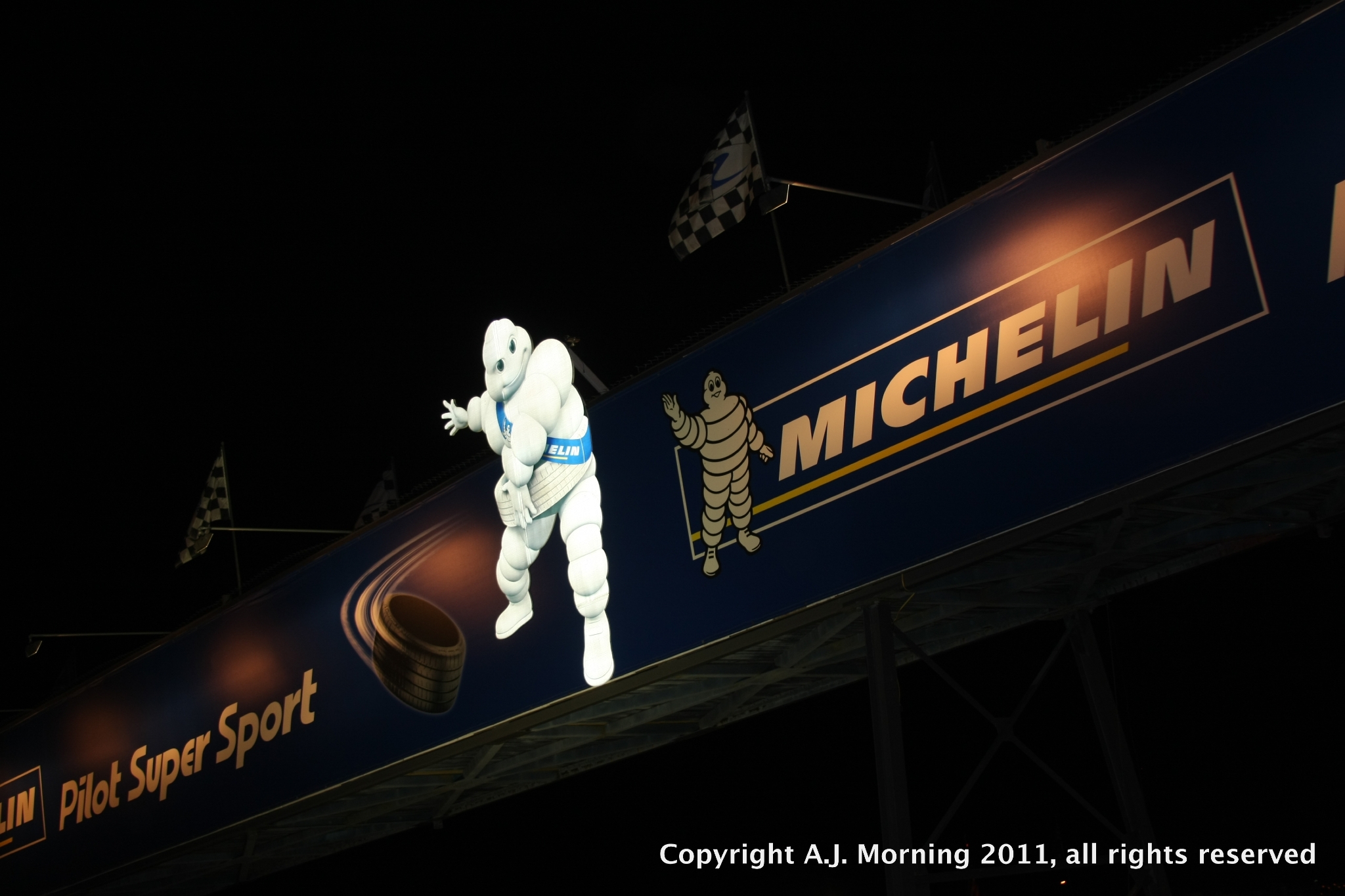
A notable change to the track was Michelin’s eye-catching new Pilot Super Sport sponsorship of the walk-over bridge near turn 17 at the track. In a nighttime flash photo, Bibendum seems to leap right off the panel, a terrific effect. The new tire, as described to me by a Michelin rep, serves a purpose similar to the walk-over bridge, in that it connects the paddock to the infield. Clever.


Sebring did not just have the most loaded-up grid in years this time around, it also had a rather densely packed infield. Compared with the last few years, the crowd seemed to fill-in earlier and thicker, and by race day it was nearly impossible to find a place to park a pogo stick in the Green Park.

However, while ORECA was carrying out the French Revolution described above and the fans were enjoying the scene trackside, many racing fans outside the track in the US and worldwide were having trouble just trying to watch it. Having ended its deal with Speed Channel (which never gave Sports Car racing 1/10th the attention it gives NASCAR), the American Le Mans Series is taking it to the web with ESPN3.com – with very mixed results.

Some of the feedback I’ve gotten, both in the US and abroad, has been quite positive. I heard from people who don’t carry cable TV but have broadband internet, who were watching Sebring for the very first time and loved it. I heard from a friend in Europe who – though the feed was at times choppy and then disappeared for 40 minutes at a time – found the whole experience exciting. I also heard from huge numbers of fans all over who were aghast – why does ESPN3.com ask me for my provider, why doesn’t this video feed work, and why did the ALMS say at first that they were serving video on their website for this race alongside ESPN3, only to later change that to overseas-only? What overpaid lawyer screwed this up?

For those who logged-on Saturday, the 12 Hours of Sebring was a glimpse of the future – a very early, not-fully-sorted glimpse – but an idea of where our sports coverage and entertainment will be in years to come.

The American Le Mans series gets an B+ for ambition in its new webcast package, but a D for execution. The concept of moving coverage from TV to the Internet is certainly forward-thinking and ahead of its time – for the moment, perhaps a bit too ahead. All of the problems facing ALMS with its new takin’-it-to-the-web deal can certainly be worked-out – and this series has always done well with making itself open and accessible to fans – but the lesson of this year’s coverage is that there’s much work left to be done.

That's it for now, I'll see you at the next pit stop.

Monday, October 19, 2009

What I learned out on the road...

Just spent the last few weeks on the road --- first Road Atlanta for Petit Le Mans (and the biggest storm in that area since Sherman), then a brilliant ride out to the Bay Area for my inaugural trip to Mazda Raceway Laguna Seca.

Anyone who's read the Petit article, thanks - it was probably one of my better ones. I had fun with it. And anyone who read the most recent one from MRLS, well, I'll just say I had to throw it together, and try to get it sent out in between power outages in Sausalito last week. Not my best journo work, though my photos are getting better by leaps.

When my babe and I first landed at SFO, we were signed up to get a "Wild Car" through Thrifty. Worked well last year, so I hoped for a similar experience. "I can get you Kia Optima, Kia Forte, PT Cruiser..." Hmm, I wouldn't mind a PT, I thought... "or for a couple more dollars, I have Mustang."

Oh, really? And you say you've got my choice of drop-top or hardtop? Let's talk further!

I ended up with a 2009 Mustang, dark red metallic, convertible.

The 4.0L V6 had over 55k on the clock, the body had several scratches and light dents (each and every one documented with the agency), and it had Hawaii license plates. I searched the trunk, however, and found no evidence of Barak Obama's birth certificate.

The only downside to this car, as I saw it, was the lack of a manual gearbox. I asked the rental agent "do you have anything with a stick-shift?" He replied no, they don't have any. "Is everyone in the area handicapped?" I don't think he got the joke, exactly.

The '09 Mustang, for a year-old hire with heavy use (the tires were brand-new BF Goodrich, thankfully), seemed as if it was at least somewhat well-maintained. Oil and other fluids looked OK, brakes felt good, and everything worked as it should. No blown fuses, no burned-out bulbs. Pre-flight cross-check, clear.

Mustang-buddies of mine will be amused that it took me over an hour in the car, before I figured out where the OD kill switch was - and who at Ford ever decided to put it there?

Our ride, which I dubbed "Mustang Sally" got us around downtown San Francisco for the first few days in a manner that would make Steve McQueen proud. Well, it at least would've been cool to Chad McQueen :) In an area with steep hills, you NEED good torque off the line, and you NEED it going to the wheels with the most traction. Aimed uphill, that's gonna' be your rears. Mustang beats all hell in that setting. I didn't make it a point to light up the tires coming off any stoplights, but it was nice knowing I could have.

On the drive to Muir Woods, we encountered some fantastic twisties that exposed the topless car's handling limits - any time you lop the roof off a car designed as a hardtop, it suffers. The 'Stang showed some chassis flex and a little cowl shake, but I was going too fast and eating the curves too quick for it to bother me. Muir Woods was a fantastic walk, and the redwoods there are astonishing.

Part 2 of the fly/drive holiday took us down Highway 1 to Monterey. Now, I've written before that "the 1" is easily the most scenic drive West of the Mississippi, but it seems like an all-new experience every time I run it. Monterey was almost as quiet and laid-back as Sebring -- a very good place to spend some time (and dollars) checking out Cannery Row and sleeping in a nice hotel... but I was really there for the race.

I had already run Laguna Seca hundreds of times on various video games. Gran Turismo has always been about which car you can get to rip through the corkscrew the fastest, so I at least had a decent concept of the track before I got there.

I was not disappointed at all.

From the top of the hill, one can see a clear shot of the corkscrew leading down to turn 9 -- and a few steps back from there, you've got a great view of turns 10, 11, and on through the front to 1 through 3. It helps if you've either got a track cart, or a buddy to give you a lift.

Speaking of - and this is a sign of the times if there ever was one - I gave Greg Creamer a ride from the paddock up to the parking area. I might not have had much good to say about the guy once upon a time, but then I got to know him. True stand-up guy, lotsa' heart, and quite a talent as an announcer.

The races themselves? A blast. Got to see Jim Hall's Chaparrals, and Jim Hall himself. When the spectacular end of the ALMS race went down, I was in the Flying Lizards' pit, talking with one of my friends on their crew. The Speed/SCCA World Challenge races the next day were fun, but by then we were pretty worn out. And my pick in the race, Boris Said, had a rough go of it.

We finished off the deal with a ride back to Sausalito, and checked in at the Inn Above Tide. The place was so nice, we hardly left for the 3 days we were in town. Of course, the fact that the Bay area was having some of the worst storms in decades, helped in that decision. But when you've got a comfy room with a fireplace, right above the San Francisco Bay, you're already where you want to be...

The flight home was, if I can complain, too short. Virgin America still stands as the best airline operating in this promised land, and if I had my way I wouldn't fly any other. I got through a couple of movies, as well as dinner and drinks on the ride home - and only spent four hours in the air from SFO to IAD. Landing at home was the downer, if there was one, but it's still pretty good to be back.

I'll have a ton more pics coming soon.